
Call for a consultation(502) 568-4700
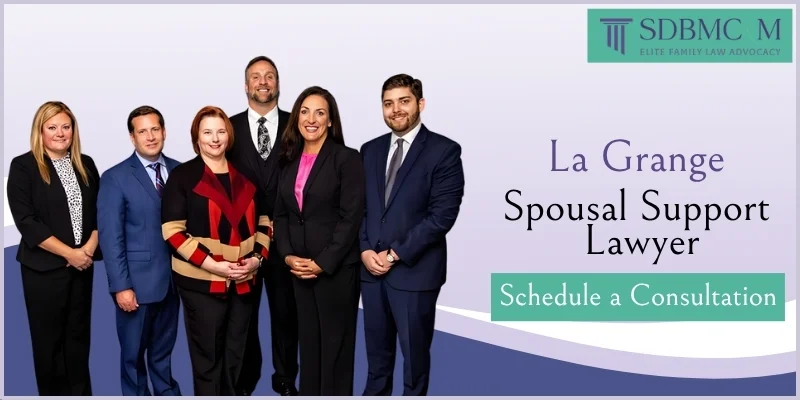
Uncertainty during divorce is incredibly stressful. These are the exact challenges Jesse Mudd addresses for families across La Grange and Oldham County. As a seasoned La Grange spousal support lawyer, Jesse turns the wide discretion of Kentucky maintenance law into a clear, reliable strategy, helping you move forward with confidence.
Jesse co-authored the Maintenance chapter of “Kentucky Domestic Relations Practice,” a leading Kentucky treatise on how spousal support gets calculated and litigated, across two separate editions spanning more than two decades. He takes a law that gives judges wide discretion and no fixed formula, and turns it into a clear number and a plan built around your case.
Contact us and tell us what worries you most, keeping your home, protecting your income, or knowing what you may owe or be owed, and we will help you find out exactly where you stand.
Spousal support, called maintenance under Kentucky law, rarely looks the same from one case to the next. Some clients need help getting money to live on while a divorce is still working its way through the Oldham County docket. Others are settling what a final decree should say, or trying to change an order that no longer reflects their life.
Our La Grange spousal support attorneys handle:
Wherever your case falls on that list, the approach is the same. We look at your full financial picture first, and build the request or the defense around what the numbers actually show, not just what feels fair in the moment.
Kentucky has no set formula for maintenance. Under KRS 403.200, a judge must first find that the spouse asking for support lacks sufficient property and cannot support themselves through work. Only then does the judge decide the amount and how long it lasts.
That discretion cuts both ways, and it rewards preparation. Present your finances clearly, and you can walk away with support that lets you rebuild. Present them poorly, and you may end up paying far more than you should, or receiving far less than you need, for years.
Kentucky law says maintenance should cover your “reasonable needs”. But the reasonable needs standard only protects you if someone has actually spelled out what your reasonable needs are. Judges in Oldham County face this question every month, and the outcome almost always comes down to how clearly the numbers are presented, not just what they add up to.
Two decades of building maintenance cases has taught our spousal maintenance lawyers what this circuit expects to see, and what a case looks like when it goes wrong.
If your case is filed at the Oldham County Judicial Center at 100 W. Main Street in La Grange, divorce and maintenance motions are heard on specific Friday dates set by the court, with paperwork due the preceding Friday by 4 p.m.
That schedule leaves little room for a filing that isn’t ready, and it rewards an attorney who knows what the clerk’s office and the bench expect to see. Jesse has spent more than two decades preparing maintenance requests for Kentucky family courts, and he knows how to build a filing that holds up the first time it is heard, rather than one that gets sent back for another round.
For clients in La Grange and the rest of Oldham County, that means fewer trips back to the courthouse and a more effective path to a support order.
Kentucky does not use a set formula. A judge first decides whether you qualify for support at all, then weighs your income, the length of your marriage, your age and health, and the standard of living you shared to set an amount and a timeline. We build your case around exactly those factors.
There is no fixed term. Support can be temporary while your case is pending, or set for months or years after your decree, depending on how long you were married and how quickly you can reasonably become self-supporting. We can give you a realistic range once we know your numbers.
You are not required to have one, but maintenance decisions in Kentucky are left almost entirely to a judge’s discretion, and an unrepresented spouse can end up accepting less, or paying more, than a fair outcome. Having a lawyer levels that discretion in your favor.
Not easily. Kentucky law sets a high bar for changing a maintenance order. You have to show that your circumstances (or your ex-spouse’s) have changed so much, and in such a lasting way, that keeping the same terms would be deeply unfair to one side. A raise or a pay cut alone usually isn’t enough; the change has to be big and it has to be here to stay.
In Kentucky, property division happens first, and the outcome of that division can affect the maintenance amount that follows. A spouse who receives more property in the divorce may need less monthly support, so the two issues have to be handled together, not separately.
An unpaid maintenance order can be enforced through the same Oldham County Family Court that issued it, including wage garnishment and contempt proceedings. If payments have stopped, contact us and we will help you get the order enforced.
You don’t have to guess what your financial future looks like, and you don’t have to face a maintenance case in Oldham County alone.
Contact Straw-Boone Doheny Banks Mudd Catalano & McKinney, PLLC today to schedule a consultation and find out where you stand, before a number gets decided for you.
Tom Banks was fantastic as he navigated numerous complex and unique legal challenges in my fight to regain equal parenting time and joint custody. I have a mental health diagnosis where I was up against a lot of mental health stigma. Tom's interest and understanding of mental health helped him…
I have worked with Thomas Banks and have known him for over 15 years. I have personally witnessed the hours and care he pours into each case and have also seen the quantifiable results at the closing of those cases. Thomas Banks has the intelligence and talent, the dedication and…
Tom Banks is nothing less than a rockstar in his field! I would never have thought I would find myself in the position I was in. Mr. Banks went above and beyond to assure my child and I were safe, secure, and the legal matters handled professionally with honesty and…
I can honestly say this law firm lived up to everything that was promised. From the very beginning, Tom took the time to explain each step, answer every question I had, and made sure I felt prepared, supported, and safe throughout the process. Even when I felt overwhelmed, he was…
As a licensed private investigator, I am familiar with the court system. I know how this process should work, and I know what good lawyers look like. Thomas Banks and his team helped me through one of the hardest times of my life. My case took a week's worth of…
I could cry trying to find the right words to thank Tom for what he has done for me. He has helped me through the most difficult season of my life and somehow made it feel easier to handle. Tom is an absolute beast in the courtroom and in strategy,…
I am very happy with the staff of the firm. Always very professional and helpful. Michele was my attorney for my divorce. Overall I was happy and was glad we were able to wrap this process up as soon as we could. A very good firm. They know what they…
If you are going through a high conflict divorce, especially with any form of abuse, go ahead and do yourself a favor and hire Tom! There are not enough good things to say about him or his staff. Tom treated my daughters and I like family and fought for five…
Mr. Thomas Banks is mine and my husbands attorney, and he always does a fantastic job!
A good place for help

With deep roots in Louisville, you can trust our history of success. Our attorneys are adept at navigating the delicate balance between vigorous advocacy and the preservation of family harmony. If you are facing family law concerns, contact Straw-Boone Doheny Banks
Mudd Catalano & McKinney, PLLC.

© 2026 Straw-Boone Doheny Banks Mudd Catalano & McKinney, PLLC• All Rights Reserved *Images are obtained under license from Canva and other third-party stock image providers, with attribution included where required.
Disclaimer | Site Map | Privacy Policy. Digital Marketing By: 